Recent Posts

Carbs and Calories In Caesar Salad: Is Caesar Dressing Keto Friendly?


If you love Caesar salad, it can be factored into a Ketogenic diet, if you’re careful… 

caesar salad carbs calories

Most of the carbs in Caesar salad come from store-bought dressings which can contain added sugar. So, if you’re following trying to lose weight, go easy on this dressing. There are also quite a few carbs in the croutons so it’s wise to omit these from the salad and use less Parmesan. 

Some people add chicken to their Caesar salad, which is a good way to boost protein, but make sure the chicken isn’t breaded, which also adds extra unwanted carbs.

Restaurant salads can have higher carb counts and the creamy, high-fat dressing can rack up a lot of calories.  For example, a Caesar Salad ordered from the popular fast food restaurant McDonald’s contains 9 grams of carbs plus another 12 grams of carbs if you eat the entire packet of dressing that comes with the salad. 

You might think Caesar salad is a healthier choice over a burger and fries, but when it’s all said and done, that McDonalds Caesar salad with dressing racks up 21 grams of carbs – an entire day’s worth of carbs for those on Keto… You might have been better off just ordering the burger! 

If you insist on ordering the Caesar salad, eat only half the dressing or a third.  Even better, prepare your own fresh Caesar salad at home so that you’re able to control the ingredients that go into it to keep carb counts in check. 

Later in this article, you’ll find a great Keto-friendly Caesar Salad Dressing recipe that will have you losing weight and feeling great!

How Many Carbs are in Caesar Salad?

One bowl of restaurant-style Caesar salad with creamy Caesar dressing can contain approximately 17 grams of net carbs. 

Keep reading to find out how to make your own healthier, low carb version of the Caesar salad…

How Many Calories are in Caesar Salad?

There are 410 calories in a typical bowl of Caesar salad with creamy Caesar dressing. 

The truth is, salad isn’t always the best diet food.  Salads ordered at restaurants can quickly become a calorie bomb. 

For instance, a chicken Caesar salad ordered from the popular restaurant, Chili’s, which consists of dressing, croutons, cheese, and chicken, will rack up 1,010 calories and a whopping 76 grams of fat!  That many calories in one setting along with all that fat can become a setback for those on a calorie-reduction plan or low fat diet.

Reduced calorie or “calorie wise” dressings are lower in calories and less fat, but may contain twice the sugar to make up for the flavor, so check the ingredient labels when making your selection. 

Origin

caesar salad keto

It is believed that Italian-American restaurateur Caesar Cardini invented the Caesar salad in Tijuana, Mexico back in 1924.   During a 4th of July celebration at his restaurant, Cardini threw together a bunch of ingredients he happened to have on hand and served his concoction to guests.  

The improvised dish became quite a hit and further evolved to an elaborated creation of romaine, garlic, croutons, olive oil, parmesan cheese, bacon bits, and black pepper topped with a creamy Caesar dressing made from raw coddled eggs.

Popular Caesar Dressing Brands           

  • Kraft Classic Caesar Dressing
  • Newman’s Own Creamy Caesar Dressing
  • Marie’s Creamy Caesar Dressing
  • Renee’s Caesar Dressing
  • Hidden Valley’s Original Caesar Dressing
  • Marzetti’s All Natural Caesar Dressing

Nutrition Facts

McDonald’s Caesar Salad (without Dressing)

Serving Size 1 salad 7.5 ounces (213 grams)
Calories 94
% Daily Value*
Total Fat 4.4 grams 6%
Saturated fat 2.5 grams 12%
Polyunsaturated fat 0.3 grams
Monounsaturated fat 1 grams
Trans fat 0.1 gram
Cholesterol 10.7 milligrams 3%
Sodium 176.8 milligrams 7%
Potassium 460.1 milligrams 13%
Total Carbohydrate 9 grams 3%
Dietary fiber 3.4 grams 13%
Sugar 4.4 grams
Protein 7 grams 14%
Vitamin A 128% Vitamin C 50%
Calcium 18% Iron 7%
Cobalamin 0% Magnesium 4%

Served with Kraft Asiago Caesar Dressing.

Serving size: 1 Packet (3 Tablespoons)
Calories 150
Fat 8 grams
Carbs 12 grams
Protein 6 grams
Sodium 400 milligrams

Health Benefits 

Vitamins, Minerals and Antioxidants

If you eat greens like Caesar salad regularly, you’ll get a good dose of powerful antioxidants, like vitamin C and E, folic acid, lycopene, alpha-carotene and beta carotene. Antioxidants help protect the body from damage caused by harmful free radicals.

A link exists between regularly consuming raw veggies (and fruits) and lower risks of disease.  The raw veggies in Caesar salad can help protect against cancer.  Individuals whose diets are rich in fruits and veggies have a lower risk of developing certain types of cancer.

High in Fiber

Eating a high-fiber diet that includes leafy green salads can help lower cholesterol levels and keep your digestive tract running efficiently.  High fiber foods, like raw veggies, also help relieve constipation.  In addition, fiber helps you feel more satiated so that you’ll eat less, and in turn lose those stubborn, unwanted pounds.

Fiber in Caesar Salad

A typical Caesar salad contains 3-5 grams of dietary fiber, depending on the size.

Fat in Caesar Salad

A bowl of Caesar salad with Caesar dressing contains 24 grams of fat, 10 of which are saturated fat.

How to Make Caesar Salad Healthier

It can be difficult ordering a healthy Caesar when dining out maybe because of large portion sizes and the fact that diners have little control over the ingredients. 

For reference, Olive Garden’s grilled chicken Caesar salad has more calories and saturated fat than a Big Mac from McDonald’s!

To make a healthier version, start with fresh Romaine lettuce, but avoid the high-calorie add-ons. 

If you make your own Caesar salad with homemade dressing, you can cut the carbs and calories by using lighter ingredients. 

Omit sugar from the dressing and swap out high carb croutons for bacon bits. 

Forgo breaded chicken and add grilled chicken instead to keep it Keto-friendly.

Keto Caesar Salad Dressing Recipe

This recipe makes approximately 1 cup.  Each serving size of 3 tablespoons contains 1 gram of carbs per serving.

chicken caesar salad dressing

Ingredients:

  • 1 cup mayonnaise
  • 1/4 cup grated Parmesan cheese
  • ½ teaspoon lemon zest
  • 2 cloves garlic, minced
  • 1 tablespoon lemon juice
  • 1  teaspoon anchovy paste
  • 1 teaspoon Dijon mustard
  • ¼ teaspoon smoked paprika
  • 1 teaspoon Worcestershire sauce
  • 1 teaspoon white vinegar
  • 1/4 teaspoon pink Himalayan sea salt
  • Fresh cracked black pepper (to taste)

Instructions:

  1. Add the mayo, anchovy paste and Dijon mustard to a large mixing bowl, whisking until combined.
  2. Mince garlic and smash it with a large cutting knife until it becomes garlic paste.  Add in the salt, smoked paprika and garlic paste.
  3. Add the Worcestershire and vinegar while whisking.
  4. Add the lemon juice and zest and combine.
  5. Add Parmesan cheese and blend.
  6. Taste and adjust the seasoning, if necessary.  
  7. Serve over Caesar salad consisting of tossed romaine lettuce pieces, fresh grated parmesan, bacon bits and/or grilled chicken slices, and a squirt of lemon.  (Hold the croutons to keep it Keto!)

Is Caesar Salad Good for Weight Loss?

Dieters often opt for Caesar salads whether dining in our out at a restaurant, but Caesar salad is one salad that can rack up a lot of calories. 

The Cheesecake Factory’s chicken Caesar salads is one of the worst culprits out there! At 1,550 calories, 23 grams saturated fat and 1664 mg sodium.  An average female can rack up her entire daily caloric intake by eating just one salad!

One trick of the dieter’s trade is to order salad dressing on the side, then just dip the prongs of your fork into the dressing before you pick up a bit of your salad.  This trick helps you consume less of the high-calorie dressing.

In addition to the dressing, the traditional Caesar salad contains other high calorie toppings, like copious amounts of Parmesan cheese.  Most cheeses are high in fat and should be eaten in moderation.  But most Caesar salads use a lot of Parmesan in both the salad and in the dressing.  

Croutons made from white bread are often cooked with oil or butter, adding unnecessary saturated fat and calories.

While topping a salad with protein can be a good way to turn that starter into a meal, fried and breaded chicken can add additional fat and calories to your Caesar salad. 

Unless you are making your own healthy version of the classic Caesar salad at home, by swapping out high-calorie ingredients for lower calorie ones, Caesar salad is not the best option for dieters.  Those watching their calorie intake should go with a garden salad instead.

Carbs and Calories In Gravy: Is Gravy Keto-Friendly?


Who doesn’t love gravy?  It’s the perfect addition to any home-cooked meal.  Whether poured over roasted meat or veggies, gravy truly jazzes up any old dish, instantly turning it into a savory, succulent feast.  

gravy calories

Some store bought gravies contain white flour or corn starch thickeners, so they can clock in at a moderate carb count, approximately 5 grams per half-cup.

Making your own homemade gravy is easy and a great way to control what ingredients get added.  Using almond flour instead of wheat flour is a great way to thicken your pan juices… Not only is this flour low in carbs, it is also very soluble – so it thickens without lumps, creating a delicious, smooth, Keto-friendly gravy.

How Many Carbs are in Gravy?

Canned and homemade gravy has 5 grams of carbs in a 100 gram serving.

Some fast food and restaurant gravies are higher in carbs.  For example, Kentucky Fried Chicken’s (KFC) gravy contains 8 grams of carbs.

How Many Calories are in Gravy? 

There are 80 calories in a 100 gram serving of canned or homemade gravy.  
(Fat and sodium content may vary, so check labels.)

Countries of Origin

In cookbooks from medieval times, gravy was once referred to as gravé – a sauce made of broth and an array of spices, and sometimes wine or ale.   By the turn of the 16th century, gravy became known as a sauce made from the drippings of meat. 

In the United Kingdom and Ireland, a Sunday roast is typically served smothered in gravy. In these regions, it is a popular sauce to go along with pork, chicken, lamb, or beef. It is also common in England, Scotland, Wales and Ireland to have gravy with just French fries or “chips” as they’re called in these parts.

In Italian cuisine, the term gravy often refers to a meat-based “ragù”. Sugo alla Bolognese came from the word succo, which could mean pan drippings or meat juices or “meat sauce.”

Gravy in America means a sauce that is made from the drippings of various types of meat or poultry.  The term is believed to have originated from the Old French word “grané”, which translated into the Middle English word “grave”.  The spelling changed over time to “gravy” – possibly a result of a misspelling that stuck.

Nutrition Facts

Gravy, canned

Amount Per 100 grams
Calories 79
Total Fat 6 grams 9%
Saturated fat 1.4 grams 7%
Polyunsaturated fat 1.5 grams
Monounsaturated fat 2.6 grams
Cholesterol 2 milligrams 0%
Sodium 424 milligrams 7%
Potassium 109 milligrams 3%
Total Carbohydrate 5 grams 1%
Dietary fiber 0.4 grams 1%
Sugar 0.8 grams
Protein 1.9 grams 3%
Vitamin A 0% Vitamin C 0%
Calcium 2% Iron 2%
Vitamin D 0% Vitamin B-6 0%
Cobalamin 1% Magnesium 0%

How to Make Gravy Healthier

The Low Carb Way to Thicken Gravy

gravy carbs

Traditionally, gravy is thickened by adding a couple of spoonfuls of all-purpose white flour or corn starch to achieve a smooth, thick consistency.  With that in mind, both white flour and corn starch are starches that add carbs to your diet.   Use an alternative low carb thickener to make a healthier gravy.  You can use almond flour as a thickener instead.   Flaxseeds that are crushed first in a food processor also help to thicken and flavor your gravy. Another option is to steam or boil vegetables such as cauliflower or zucchini and then blend them into a puree to use in your gravy in place of flour.

The Low Fat Method of Making Gravy

Gravies for meat and poultry are traditionally made with the fat drippings from the cooking pan. This fat added back to the meal increases the calories and the risk of high cholesterol and heart disease.  A healthier version of homemade gravy is made using chicken or vegetable stock instead. Simply add spices and a low-carbohydrate thickening option such as whole-wheat flour to the stock to make a healthier gravy.

To skim the fat when making gravy (as well as soups and stews), refrigerate and remove the fat that solidifies on top with a large spoon.  To speed up the process, place a few ice cubes in a gravy (or soup).  The fat will harden at the surface quickly, making it easier to remove.  Then simply re-heat for a delicious gravy sauce (or soup) with all of the flavor, but much less fat.

Creamier gravies like England pork white gravy sauce, contain milk or cream to give them a rich, creamy texture. These additions increase the fat content of your gravy, so you may be consuming more calories with your lean meat and poultry than you thought. Instead, try using skim milk powder or skim milk to your gravy to make it creamy.  Pureed boiled cauliflower is another great low carb hack for a creamier gravy. 

Reduced Sugar Gravy

gravy keto

If you are making a sweeter gravy, try a splash of cinnamon vanilla, nutmeg, or a dollop of applesauce instead of adding sugar.  Your palate will be intrigued by that certain ‘je ne sais quoi’ these alternatives provide to your home-style gravy recipes.

Reduced Sodium Gravy

Canned and restaurant style gravies are typically high in salt or sodium for additional flavor.   An excess of salt can lead to high blood pressure and heart disease. You can use other spices instead of salt to make a delicious gravy that is lower in sodium.  Choose from a variety of dried or fresh spices like sage, thyme and rosemary.   Don’t be afraid to experiment with all kinds of herbs and spices; like, garlic, chives, parsley, oregano, pepper, onion, celery seed, ginger powder, and dill. Just chop up your favorite herbs and add them into your gravy in place of salt. There are also some great dried herbs at the grocery store as well.  I love the ones put out by the brand, Mrs. Dash. 

Keto-Friendly Homemade Gravy

Ingredients:

  •  2 Cups chicken or beef stock
  • ½ Small onion, diced
  •  2 Beef or chicken bouillon cubes (depending on the meat you’re serving)
  •  Fat drippings from chicken or beef (or 3 tablespoons of butter for meatless dishes)
  • ¼ Teaspoon dried thyme
  • ½ Teaspoon garlic powder
  •  ½ Teaspoon dried rosemary
  •  3 Tablespoons almond flour
  •  1 Teaspoon onion powder
  •  Fresh Ground black pepper to taste

Instructions:

  1. Combine the stock and bouillon cubes in a pot, heating for a few minutes while stirring until bouillon is dissolved.
  2. Melt the butter in a separate saucepan over medium-high heat or fat drippings if you are using chicken or beef fat drippings from your roast instead of butter.  You can even keep some small bits of meat in your gravy as well for added flavor.  Sautee diced onions in the fat until softened and translucent.
  3. Whisk in the almond flour and spices. Cook for a minute or two while continuing to whisk until gravy is smooth and free of lumps.
  4. Pour in the stock slowly a little at a time while continuing to whisk until smooth.  Bring gravy to a rolling boil.
  5. Simmer for a few minutes to reduce while whisking until gravy thickens.  Season with salt and pepper to taste.  
  6. Remove from heat and enjoy over your meat of choice and low carb veggies!

Can Vegetarians and Vegans Still Have Gravy?

Campbell’s or Heinz Mushroom Gravy is a safe bet if you’re vegan or vegetarian.  This mushroom-flavored gravy is delicious when poured over low carb veggies. 

If you’re not a fan of mushroom gravy, the bouillons in some brands of canned meat flavored gravy may not contain any actual meat.  Just check the label to be sure.  Vegans and vegetarians can often enjoy the taste of meat without consuming any real meat as many brands contain only meat flavorings, which are cruelty-free.

Carbs and Calories In Couscous: Is Couscous Keto Friendly?


Couscous is high in carbs, at 36 grams per cup.  Foods made from grains like couscous, bread, rice, and pasta do not make the list of approved Keto foods.  Couscous should be avoided while following the Keto diet or strictly limit your serving size to 1/4 cup serving to be eaten as part of a larger meal. 

couscous carbs

If you add a small amount of couscous to your meal plan, top it with a serving of meat or protein and veggies.  It is best to consume couscous with other sources of protein or foods rich in fiber to balance out blood sugar levels. 

In this article, I have included a low carb Moroccan stew recipe with cauliflower couscous, a great low carb alternative to traditional couscous.  So keep reading…

How Many Carbs are in Couscous?

  • A 100 gram serving of cooked couscous contains 23 grams of carbs.
  • A full cup of cooked couscous contains 36 grams of carbs.

How Many Calories are in Couscous?

  • There are 112 calories in a 100 gram serving of cooked couscous.
  • There are 176 calories in a full cup of cooked couscous.

What is Couscous?

Couscous (كُسْكُس‎) is originally a dish from the Maghrebi regions made up of small steamed balls of crushed durum wheat semolina (about 3 millimeters in diameter).  Although it can be eaten on its own, couscous is traditionally topped with a stew made of meat and veggies.

Pearl millet, sorghum, and other cereals can be cooked using a similar method are also sometimes called “couscous”. 

In North American supermarkets, couscous is often sold in instant form with a flavor packet. 

Origin

The origin of couscous originates from the eastern and northern regions of Africa, where it was consumed by Berbers as early as the 7th century.  In traditional North African cuisine, it is a popular delicacy among Maghreb countries.  Couscous is a staple food throughout the North African regions of Algeria, Mauritania, Libya, Israel, Morocco and Tunisia. 

Nutrition Facts

Serving Size: 100 grams of Cooked Couscous
Calories 112
Total Fat 0.2 grams 0%
Saturated fat 0 grams 0%
Polyunsaturated fat 0.1 grams
Monounsaturated fat 0 grams
Cholesterol 0 milligrams 0%
Sodium 5 milligrams 0%
Potassium 58 milligrams 1%
Total Carbohydrates 23 grams 7%
Dietary fiber 1.4 grams 5%
Sugar 0.1 grams
Protein 3.8 grams 7%
Vitamin A 0% Vitamin C 0%
Calcium 0% Iron 2%
Vitamin D 0% Vitamin B-6 5%
Cobalamin 0% Magnesium 2%

Health Benefits

couscous calories

Rich in Selenium

Couscous is rich in the vital nutrient, selenium.   Just one cup of cooked couscous contains more than 60% of the recommended intake of selenium.  Selenium is an important mineral with many nutritional benefits.   It is a powerful antioxidant that decreases inflammation in the body and repairs cells damaged by free radicals.

Selenium plays a role in thyroid health as well, protecting it against damage and assisting in hormone production.

The selenium that is abundant in couscous helps lower your risk of heart disease by reducing LDL cholesterol from arteries.

Strengthens the Immune System

The selenium in couscous can boost your immune system as it plays a role in the regeneration of vitamins C and E.  Not only does this antioxidant reduce inflammation in the body, it strengthens your body’s immunity by reducing oxidative stress.  A deficiency in selenium may harm immune cells and their function.

Good Source of Plant-Based Protein

calories couscous

It is vital to consume plant proteins as they contain amino acids that are involved in almost every metabolic process in your body.  Couscous is a great source, providing 6 grams of plant based protein per cup.  Individuals who consume plant-based protein regularly are known to have a reduced risk of stroke, cancer and heart disease.

Helps Lower the Risk of Cancer

The selenium in couscous may also help lower your risk of cancer.  Studies show that high selenium blood levels from eating selenium-rich foods like couscous may protect against certain types of cancer.

Increased risk of prostate cancer has been linked to selenium deficiency.  Consuming selenium-rich foods like couscous regularly, along with vitamins C and E, has been shown to decrease the risk of lung cancer.

High in Fiber to Aid Digestion

Did you know 80% of your immune system resides in the gut?  The fiber in couscous supports gastrointestinal health by aiding in digestion and assisting gut health.  Couscous is often considered a healthy alternative to pasta since it’s made from whole-wheat flour. Other types of pasta are typically more refined.  The fiber in whole grains like couscous functions as a prebiotic, which enhances immunity.

Keto Moroccan Couscous Recipe
(Made with Cauliflower Couscous)

Stew Ingredients:

  • 1 ½ pound of beef steak 
  • 2 tablespoons olive oil
  • 1 small sweet onion, chopped
  • 1 small zucchini, diced
  • 1 small eggplant, diced
  • ½ red pepper, diced
  • 1 celery stalk, diced
  • 1 cup beef broth or bone broth
  • 2 tablespoons harissa seasoning
  • 5 cloves of garlic or 2 teaspoons garlic powder
  • 1 large can of crushed tomatoes (400 grams)
  • 1 teaspoon pink Himalayan sea salt
  • 1 teaspoon fresh cracked black pepper
  • Fresh or dried mint leaves (for garnish)

Cauliflower Couscous Ingredients:

  • 2 tablespoons butter
  • 1/2 head cauliflower, crumbled in food processor
  • 1 teaspoon cumin
  • 3/4 cup beef broth 
  • 4 tablespoons sliced almonds
  • 3 stalks spring onions sliced
  • ½ celery stalk diced.
  • 1/2 teaspoon salt
  • 1/2 teaspoon pepper

Instructions:

  1. Chop all vegetables for the stew and cut the beef into 1 inch squares.  Sautee the chopped onion, eggplant and zucchini on low heat with one of the tablespoons of oil. 
  2. In a separate frying pan, heat another spoonful of oil over medium- high heat and braise the beef evenly while turning.   Combine with vegetables and continue to simmer for 1 hour on medium-low heat, while stirring occasionally, until meat is tender and cooked through.
  3. Add the remaining stew ingredients and pour stock over the meat and vegetables.
  4. In another large frying pan, melt the butter over medium-high heat. Add the cauliflower and fry for 2 minutes until it achieves a golden brown coloring. 
  5. Add the stock and cumin and stir to combine. Turn the heat down to low and simmer for about 10 minutes until the liquid is reduced and the cauliflower is cooked through.
  6. Add in spring onions and combine. 
  7. Serve the cooked stew over couscous and garnish with a few mint leaves on top.  (Makes 6 servings.)

How to Prepare Couscous:

carbs in couscous

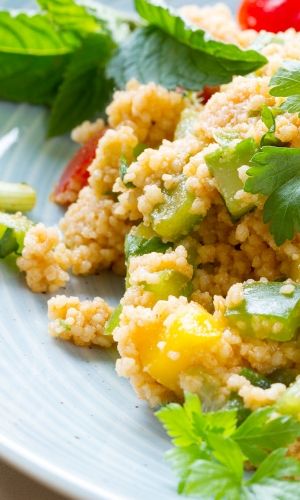
Couscous is a very versatile food that accompanies many dishes.  Much like tofu, it tends to take on the flavor of other ingredients. When cooked, couscous is light and fluffy, like rice.   

Couscous is quite simple to cook.  All you need is boiling water.  Much like the process of cooking rice, it is important to use the correct ratio of couscous to water. For most types of couscous, use 1 and a half cups of water to every cup of couscous. 

The instant version sold in North American supermarkets has been pre-steamed and dried. You just need to add water or broth and boil for the amount of time listed on the package.  Then simply fluff with a fork and serve.

Couscous can be added to salads or served as a side dish with meats and vegetables to add more nutrients and amino acids to your diet.

Side Effects

Couscous is made of hybridized wheat that is genetically modified. 

Couscous also contains gluten and should be avoided by those with gluten sensitivities or Celiac disease. 

This grain is also very high on the glycemic index, ranking a 65 per 100 grams.  Diets that are high on the glycemic index can contribute to type 2 diabetes and heart disease.

Fiber in Couscous

A 100 gram serving of cooked couscous contains 1.4 grams of dietary fiber, which is about 5% of your daily requirements.

Protein in Couscous

There are 3.8 grams of protein in a 100 gram serving of cooked couscous.

Gluten in Couscous

Those with gluten allergy or celiac disease should be aware that couscous contains gluten.  Individuals who are sensitive to gluten will greatly benefit from eliminating gluten from their diets.  People with celiac disease should not consume couscous.

Is Couscous Good For Weight Loss?

The best thing about couscous is that it is low in calories, which makes it an ideal dietary food.   At less than 200 calories in each cup, a serving of couscous contains less than 10% of the daily calorie intake recommended for adults.  This makes it a good food option for people trying to lose weight through dieting.

Carbs and Calories in Ketchup: Is Ketchup Keto Friendly?


calories ketchup

Traditional store bought ketchup contains a substantial amount of sugar, or worse, corn syrup.  Although the nutritional breakdown varies by brand, there is approximately a teaspoon of sugar in each tablespoon of ketchup.  So eat ketchup in sparingly while following a low carb diet, like Keto.

If you tend to go overboard on ketchup, it’s best that you avoid this condiment on the Keto diet.  However, you can enjoy a small amount of ketchup in moderation on the Keto diet. 

One tablespoon is a good limit for those on a low carb diet.  That may not sound like much, but if you consume more than that, the carbs can really add up!  Two tablespoons of ketchup contain 9 grams of carbs – too much for a condiment. 

Excess sugar spikes insulin, which can cause you to feel hungrier and in turn, eat more.  When insulin spikes, you may not physically hungry; however, you may still experience gnawing desire to eat.  This phenomenon is called insulin resistant hunger.

There are some sugar-free ketchup brands which use artificial sweeteners instead of sugar, which are a better option for folks following the Keto diet. 

Or make your own homemade sugar-free ketchup instead! It has only 1 gram of natural sugar (fructose) per tablespoon, which is solely from tomatoes.  I have included the full recipe in this article, so keep reading…

How Many Carbs are in Ketchup?

  • One tablespoon of ketchup contains 4.5 grams of carbs.
  • A 1/4 cup of ketchup contains 16 grams of carbs.

How Many Calories are in Ketchup?

  • One tablespoon of ketchup contains 19 calories.
  • A 1/4 cup of ketchup contains 67 calories.

Nutrition Facts

Serving Size:  1 tablespoon of Ketchup (17 grams)
Calories 19
Total Fat 0 grams 0%
Saturated fat 0 grams 0%
Polyunsaturated fat 0 grams
Monounsaturated fat 0 grams
Cholesterol 0 milligrams 0%
Sodium 154.2 milligrams 6%
Potassium 53.6 milligrams 1%
Total Carbohydrate 4.5 grams 1%
Dietary fiber 0.1 grams 0%
Sugar 3.7 grams
Protein 0.2 grams 0%
Vitamin A 1% Vitamin C 1%
Calcium 0% Iron 0%
Vitamin D 0% Vitamin B-6 0%
Cobalamin 0% Magnesium 0%

Ketchup Origin

carbs ketchup

Did you know that ketchup was once traditionally a condiment made from egg whites, mushrooms, oysters, mussels, or walnuts?  But today, the term ketchup (also called catsup, ketsup, red sauce, and tomato sauce) typically refers to tomato ketchup.

Ketchup, as we know and love it today, is a sweet and tangy sauce made from tomatoes, sugar, and vinegar, and an assortment of spices. The seasonings may vary among different brands, and can include onions, allspice, coriander, cloves, cumin, garlic, and mustard.  Celery, cinnamon or ginger can sometimes be added as well.

Heinz is the market leader in the United States and in the United Kingdom. Hunt’s has the second biggest share of the US market.  In most parts of the UK, Australia and New Zealand, ketchup also called “tomato sauce” or “red sauce”.   Ketchup is used as a condiment to foods like burgers, fries, hot dogs and even on scrambled eggs, but the options don’t end there.  It can also be brushed over grilled meat, added to recipes like meatloaf and meat pies, or used as marinate for steak.

Ketchup Brands

  • Heinz
  • Hunts
  • Sir Kensington
  • French’s
  • Annie’s
  • Del Monte
  • Tops

Health Benefits

If you love ketchup, don’t beat yourself up overeating a lot of it.  This popular condiment is actually associated with some pretty amazing health benefits.  For starters, ketchup is very low in saturated fat and cholesterol.  It is also rich in vitamin C and potassium.  It is also a good source of vitamin A, a key nutrient to support a healthy immune system and healthy eyesight.

Ketchup is a good source of Lycopene.  Lycopene is known to inhibit the androgen receptor expression in prostate cancer cells.  This important antioxidant also reduces prostate cancer cell proliferation and modulate cell-cycle progression.  You can get a good dose of lycopene from tomatoes and tomato products like pasta sauce and tomato juice as well.

Men who eat tomato sauce a few times a week can reduce their risk of prostate cancer.  According to a 2002 study of 47,000 men conducted in the united stated, the risk is reduced by around 20%.

keto ketchup

Lycopene, which gives tomatoes their red color, could also help improve fertility in men, another study discovered.  The powerful antioxidant, lycopene may increase sperm count by up to 70%.  Regular consumption of lycopene rich foods like ketchup also increases swimming speed of sperm and reduce the number of abnormal sperm in semen samples.

Tests carried out in Finland found that ketchup could reduce LDL cholesterol, the unhealthy type of cholesterol.  In a 2007 study, subjects who consumed ketchup with each of their daily meals saw a significant reduction in LDL cholesterol levels by 13%.

Side Effects

Tomato ketchup is high in sugar and sodium.  This food is not a good source of fiber or protein.

The distilled vinegar that goes into making this condiment made from genetically modified (GMO) corn, which is laced with chemicals and pesticides.

Ketchup contains concentrated, cooked down tomatoes that are strained to remove seeds and skin, and then they are cooked again for several hours over high heat.  This cooking process removes many of the essential vitamins and minerals naturally contained in tomatoes.

The main ingredient, high fructose corn syrup, is a very unhealthy additive.  High fructose corn syrup is also made from corn that has been genetically modified. Corn syrup raises blood sugar levels in the body and is a main cause of obesity, diabetes and heart disease.

Other Uses

  • Use ketchup to polish tarnished copper, like costume jewelry.
  • Use it to shine anything made of silver, like silverware.
  • Use it to shine your car’s alloys.
  • Use it as marinate for meats, like steak.
  • Use it to tone ash blonde hair and achieve a more natural golden hue.
  • Use it to repair chlorine damaged hair and remove green tones from tresses.
  • Use it to remove rust from metals by covering the rusted item in ketchup and waiting a few hours before rinsing.
  • Use it as fake blood for Halloween costumes or for actors in scary screenplays.
  • Use it on paper with your kits as a non-toxic finger paint.
  • Use it on your skin to soothe bug bites.

Quick and Easy Keto Ketchup Recipe

Ingredients:

  • ¾ cup tomato paste
  • 1 cup water
  • 4 tablespoons stevia or natural sweetener of choice that measures like sugar.
  • 3 tablespoon white vinegar 
  • 2 teaspoons pink Himalayan sea salt
  • 1/4 teaspoon mustard powder
  • 1/2 teaspoon onion powder
  • 1/2 teaspoon garlic powder
  • 1/4 teaspoon smoked paprika

Instructions:

  • Whisk all ingredients in a small saucepan while simmering over low heat, until smooth.
  • Reduce for about 20-30 minutes over low heat, with a cover, until the ketchup thickens. Stir occasionally while simmering.
  • Taste the ketchup and adjust seasonings, if desired. You may wish to add more sweetener or salt at this point.
  • Pour the ketchup into a blender and puree for a few seconds until the texture is smooth. 
  • Transfer to a sterilized container and refrigerate.  You can store it in the cupboard, but it has a longer shelf life in the refrigerator.

Sugar in Ketchup

ketchup calories

Ketchup and tomato sauce, two of the most popular tomato-based products, are often loaded with sugar. Ketchup provides 1 teaspoon of sugar per 1 tablespoon of product. Considering most people use double that amount, if not more, this can quickly add up.

Potassium in Ketchup

Tomatoes are a high potassium fruit.  There are over 53 milligrams of potassium in just one tablespoon of ketchup.  Condensed tomato products like ketchup and tomato paste rack up a lot of potassium in just a small amount.  For this reason, consuming ketchup on a regular basis can help you achieve your daily potassium needs. 

Gluten in Ketchup

Heinz, the most popular American brand is gluten-free.  Those sensitive to vinegar made from wheat grains, can rest assured.  Heinz reports that its distilled vinegar is made from corn, not wheat.  If you normally use another brand, just check the product label to ensure there is no wheat or wheat-based products added. 

Carbs and Calories in Mayonnaise: Is Mayo Keto Friendly?


calories mayo

Mayonnaise is high in healthy fats, yet low in carbs, making it an ideal Keto condiment.

Don’t be afraid to slather mayo on your sandwiches and burgers or add it to your tuna salad and egg salad.  Mayonnaise is a perfect low carb condiment that makes the approved Keto foods list.   

Mayo made with avocado oil or olive oil are the best types for health. These oils have a neutral flavor that makes a delicious low carb mayonnaise. 

I have included a delicious low carb mayonnaise recipe later in this article, so keep reading to find out how you can make your own healthy mayo at home.

How Many Carbs are in Mayonnaise?

One tablespoon of mayonnaise is almost carb-free, containing a mere 0.1 grams of carbs.

100 grams of mayonnaise contains only 0.6 grams of carbs.

How Many Calories are in Mayonnaise?

One tablespoon of mayonnaise contains 94 calories.

100 Grams of mayonnaise contains 680 calories.

Light and Low Fat Mayonnaise Style Dressings

mayonnaise keto

While most restaurants don’t use the low-fat version of mayo, you can purchase reduced calorie or reduced fat mayo-style dressings to use at home.  However, be careful to check the ingredient labels on the “light” or “calorie-reduced” versions to ensure the product doesn’t add extra sugar to make up for lost flavor.

Low-fat mayonnaise can be a better option.  Hellman’s low-fat mayo contains less than 1 gram of sugar per serving.

Any food product labelled “light” will contain 1/3 less calories than the original version.  In a 1 tablespoon amount of light mayo, there is 45 calories and 5 grams of fat.

Food products labelled as “low fat” or “reduced fat” contain 25% less fat than the original version.  One tablespoon of reduced fat mayonnaise contains 25 calories and 2 grams of fat.

Mayonnaise made with canola oil, avocado oil, or olive oil are much healthier options. Keep in mind that these varieties contain heart-healthy monounsaturated fats, but the calorie counts are the same. 

Other oils may be added in to some brands along with olive oil, like vegetable oil, so that the flavor is more subtle.  You should avoid these types, as vegetable oil isn’t a heart healthy fat.

Let’s take a look at the calories, fat and carb counts in each type of healthier mayo:

Canola oil mayo: 100 calories, 11 grams fat, 0.5 grams carbs.

Olive oil mayo: 100 calories, 12 grams fat, 0.1 grams of carbs.

Reduced fat olive oil mayo: 45 calories, 4 grams fat, 2 grams of carbs.

Nutrition Facts

Serving size: 1 Tablespoon of Mayonnaise
Calories 94
Total Fat 10 grams 15%
Saturated fat 1.6 grams 8%
Polyunsaturated fat 6 grams
Monounsaturated fat 2.3 grams
Trans fat 0 grams
Cholesterol 5.8 milligrams 1%
Sodium 87.6 milligrams 3%
Potassium 2.8 milligrams 0%
Total Carbohydrate 0.1 grams 0%
Dietary fiber 0 grams 0%
Sugar 0.1 grams
Protein 0.1 grams 0%
Vitamin A 0% Vitamin C 0%
Calcium 0% Iron 0%
Vitamin D 0% Vitamin B-6 0%
Cobalamin 0% Magnesium 0%

Popular Mayo Brands

  • Helmond’s
  • Miracle Whip
  • Kraft
  • Duke’s
  • Blue Plate
  • Best Foods
  • Oasis Select

Ingredients

Mayonnaise consists of eggs, vinegar, oil, salt, sugar, and sometimes other spices.

Mayonnaise Recipe – Make it Keto!

mayonnaise low carb

To avoid the unhealthy additives in commercial store-bought mayonnaise, you can make your own homemade mayo.  That way you can use healthier oils and avoid adding sugar and other non-organic ingredients like preservatives.

This classic Keto-friendly mayo recipe calls for avocado oil, olive oil or canola oil, which are heart-healthy monounsaturated fats.  If you’re feeling creative, try adding a spoonful of pesto, curry, garlic, tobacco or hot sauce to make an extra fancy homemade mayonnaise.

Ingredients:

  • 1 egg yolk
  • 3 tablespoons apple cider vinegar
  • ½ lemon (juiced)
  • ½ teaspoon garlic powder (optional)
  • 3/4 cup avocado oil, canola oil or olive oil
  • ½ teaspoon pink Himalayan sea salt
  • ½ teaspoon smoked paprika
  • ½ teaspoon dried mustard
  • ½ teaspoon white pepper (optional – for a spicier mayo).

Instructions:

  1. In a food processor, combine egg yolk, vinegar, lemon juice, sea salt, paprika, mustard, and garlic powder and blend for 1 minute until mixed well.
  2. Slowly pour in about a tablespoon of avocado oil while still blending, a little bit at a time while waiting a few seconds between for the oil to emulsify.
  3. Once the mayo thickens to the correct rich and creamy consistency, transfer to a sterile mason jar and refrigerate. This mayo keeps in the refrigerator for up to 2 weeks.

Health Benefits 

Mayonnaise is a great source of vitamin E.  Vitamin E is an antioxidant that protects cells from damage and helps prevent heart disease and cancer.  Antioxidants also help block free radicals from damaging your body’s cells. Vitamin E prevents cholesterol build-up in the blood.

Another vital nutrient contained in mayonnaise is vitamin K.  Vitamin K plays a vital role in blood coagulation for wound healing, bone metabolism, and the regulation of blood calcium levels.  

Side Effects

Overeating mayonnaise may lead to excess cholesterol build-up in your arteries.

Mayonnaise is processed food and has very high salt which may lead to high blood pressure.   There is 26% of your daily recommended value of sodium in a 100 gram amount, so eat mayo in moderation.  Enjoy only 1 or 2 tablespoons instead, which contains only 3% – 6% of your daily sodium needs, respectively.

Other Uses

mayonnaise calories

To Condition Hair

Mayonnaise makes an amazing treatment for dry, damaged hair because it contains ingredients like lemon juice, vinegar, and oils that include fatty acids – which are all great for hair health.  Mayo also contains vitamins that can boost shine and lustre, while helping to seal in moisture.

To Moisturize Skin

Because mayonnaise is made with oil and eggs, it can soften dry skin and preserve moisture in skin cells. Mayonnaise made up of olive oil, canola oil, or avocado oil can be used topically to treat dry skin, as well as sunburned skin.  Apply it to the face or area with dry skin and leave it on for a few minutes.  Rinse the mayo and then notice how much more moisturized your skin will become…. Your complexion will be glowing!

Fat in Mayonnaise

Canola oil, avocado oil and olive oil are healthy oils that contain fewer calories are healthier options for the heart.  These varieties are high in heart-healthy monounsaturated fat – the healthy fat your body needs.

Reduced fat mayonnaise or low fat mayonnaise-style dressings like Miracle Whip were originally created as a cheaper alternative to producing classic mayonnaise. It contains many of the same ingredients, but uses less oil. Miracle Whip adds water, sugar, and a unique blend of spices to give it that tangy “zip”.

Sugar in Mayonnaise

Regular mayonnaise contains only 1 gram of sugar per tablespoon, which is fairly low as long as you limit yourself to only a tablespoon per serving.  

If you believe you are doing your body a favour by choosing light, calorie-reduced mayonnaise, think again. Calorie-reduced or light mayonnaise usually contains more added sugar (4 grams per tablespoon, the equivalent of a full teaspoon of sugar per tablespoon). Mayonnaise, especially the low-calorie variety, is not a good choice if you are trying to restrict sugar and carbs.

Is Mayonnaise Good for Weight Loss?

Although mayonnaise filled with calories and fat, it is low in carbs.   If you follow a low carb diet plan, like Keto, mayonnaise could help support weight loss.  However, since mayonnaise is mostly oil, it is calorie-dense.  If you are following a calorie-reduction diet plan, it could hinder weight loss. 

Mayo is mostly unsaturated fat, which is a healthier fat.  So it can be perfectly fine to include a tablespoon of mayo in place of a fat serving, instead of using butter or oil.

The sugar used in mayo is a simple carbohydrate that raises your body’s insulin levels, which promotes storage of fat in your body, rather than the burning of fat.  Luckily there is only a small amount of sugar in mayo, however some light brands might add more to account for lost flavor, so be sure to check the product labels. It is best to avoid added sugar wherever possible while on a weight-loss diet program.

Sometimes mayo contains vegetable oils like soybean oil, which are not considered healthy fats. Avoid these varieties, and choose brands that use canola oil, avocado oil or olive oil. 

Although mayo is high in fat, you don’t have to banish it completely from your food repertoire.  Mayo can be a part of a healthy diet when eaten in moderation. If you’re trying to cut back on additives like extra sugar, vegetable oils and preservatives, you can always make your own healthy homemade mayonnaise so that you can control the ingredients that get added into your recipe.

Carbs and Calories in Mustard: Is Mustard Keto-Friendly?


mustard keto

Most mustards, with the exception of honey mustard, are sugar-free.  Great news for Keto dieters!

If mustard, ketchup and mayonnaise were to compete in a contest for the prize of best Keto condiment, mustard would win the gold medal.  Ketchup is full of sugar and mayo is full of fat; but mighty yellow mustard contains no significant amounts of sugar or fat. Mustard is a superstar sauce for low carb diets, like Keto.

Mustard makes the perfect low-calorie alternative to many high calorie condiments.  Just be sure to double-check your product labels as some mustard brands could sneak in sweeteners and trace amounts of fat.  

Traditional yellow mustard and Dijon mustard are carb-free, however some honey mustard brands could contain up to 10 grams of carbs. 

How Many Carbs are in Mustard?

  • Fresh Mustard:  One teaspoon of fresh mustard contains 0.3 grams of carbs.
  • Dried Mustard:  One teaspoon of dried mustard contains 0.6 grams of carbs.
  • Dijon Mustard:  One teaspoon of Dijon mustard contains 0.3 grams of carbs.
  • Honey Mustard:  One teaspoon of Honey Mustard contains 1.2 grams of carbs.

How Many Calories are in Mustard?

  • Fresh Mustard:  One teaspoon of fresh mustard contains only 3 calories.
  • Dried Mustard:  One teaspoon of dried mustard contains 10 calories.
  • Dijon Mustard:  One teaspoon of Dijon mustard contains 3.1 calories.
  • Honey Mustard:  One teaspoon of Honey mustard contains 23 calories.

Mustard Scientific Name

The scientific name of field mustard is Brassica rapa subsp oleifera.
The scientific name of brown mustard is Brassica juncea.
The scientific name of black mustard is Brassica nigra.

Popular Mustard Brands

  • French’s Yellow Mustard
  • Heinz Mustard
  • Keen’s Mustard
  • Colman’s Mustard
  • Grey Poupon Dijon Mustard (Kraft)
  • Plochman’s Mustard
  • Kraft Honey Mustard

Ingredients

mustard calories

Traditional yellow mustard is a popular condiment made from the seeds of the mustard plant. The mustard seeds are ground down and then mixed with water, vinegar, lemon juice, wine, or other liquids, salt, and often other flavorings and spices. The result is a yellow to brown colored paste or sauce.

French’s brand mustard contains only a few simple ingredients:  Distilled vinegar, water, mustard seed, salt, turmeric, paprika, natural flavors and garlic powder.

Nutrition Facts

Serving Size:  1 Teaspoon or 1 packet (5 grams)
Calories 3
Total Fat 0.2 grams 0%
Saturated fat 0 grams 0%
Polyunsaturated fat 0 grams
Monounsaturated fat 0.1 grams
Trans fat 0 grams
Cholesterol 0 milligrams 0%
Sodium 56.8 milligrams 2%
Potassium 6.9 milligrams 0%
Total Carbohydrate 0.3 grams 0%
Dietary fiber 0.2 grams 0%
Sugar 0 grams
Protein 0.2 grams 0%
Vitamin A 0% Vitamin C 0%
Calcium 0% Iron 0%
Vitamin D 0% Vitamin B-6 0%
Cobalamin 0% Magnesium 0%

Health Benefits (Mustard Seeds)

Mustard is typically consumed in small amounts as a condiment, and therefore it doesn’t provide any significant health benefits.  However, mustard seeds are rich in calcium, manganese, omega 3 fatty acids, iron, zinc, protein and dietary fiber.  Mustard seeds assist in digestion and increase the metabolism rate of your body.  These special, little seeds may even help treat some health conditions, like Asthma.  

The minerals selenium and magnesium contained in mustard seeds help prevent cancer, and manage symptoms of asthma and arthritis. Mustard seeds can help a poor appetite if eaten before a meal.  These trace minerals also help reduce high blood pressure.

carbs mustard

Mustard seeds have been around for thousands of years and are known to have wonderful health benefits.  These seeds even have antibacterial and antiseptic properties.  They’re rich in selenium, which has anti-inflammatory qualities and they’re a great source of magnesium. 

Mustard seeds help to reduce the symptoms of asthma attacks and rheumatoid arthritis.  They also provide relief from headaches and various types of migraines. 

Side Effects

Mustard is recognized as safe by the United States Food and Drug Administration when consumed in normal food amounts. However, if you use mustard for medicinal uses, you should exercise caution.

Applying white or black mustard topically to the skin for an extended period of time can cause burns, blisters, or ulcers.  Consuming large amounts of black mustard seed by mouth can damage the throat and cause side effects including heart failure, diarrhea, drowsiness, breathing difficulties, coma, and even death.

Mustard and mustard seed allergies are common among the general public.  Mustard leaves, seeds and flowers, sprouted mustard seeds, mustard oil are likely to cause reactions in people with a mustard allergy.

Allergic reactions to mustard may be mild or severe and generally arise immediately after consuming the mustard product.  If you have an allergy to mustard, you may experience a rash or a tingly, itchy sensation in the mouth. Difficulty breathing is another common symptom of mustard allergy. 

Medicinal Uses

Mustard seeds are used for the treatment of various illnesses.  It is believed that taking mustard medicinally may help alleviate conditions like asthma.

White mustard seed can be used to clear the voice, increase urination, prevent infection, or boost appetite.

Black mustard seed can be used to treat the common cold, reduce joint and muscle pain, and alleviate arthritis symptoms.

Cosmetically, mustard seeds can be used for healthier hair, skin, and nails.

Currently, there is not enough scientific evidence to support any of these medicinal or cosmetic claims, however, people continue to use mustard or mustard seed as a folk medicine remedy.

Fiber in Mustard

There are 0.2 grams of fiber in a teaspoon of mustard.

Sugar in Mustard

Most mustards, with the exception of honey mustard, are sugar-free.  However, some brands may sneak in added sweetener, so be sure to check the product label to be sure.

Related Questions:

mustard low carb

Is Mustard Gluten-Free?

All of French’s prepared mustards are gluten-free except for French’s Tangy Sweet & Smooth BBQ Mustard, which contains gluten.

Is Mustard Vegan?

Although honey mustard and Dijon mustard may contain animal products, traditional yellow mustard is typically vegan. The ingredients like vinegar, salt, spices, and mustard seeds are all vegan.  Even the thickener, xanthan gum that is sometimes used in mustard is plant-based.  If you’re unsure, just double-check the product label to ensure it doesn’t contain animal products.

Is Mustard Oil Safe to Use in Cooking?

The use of mustard oil is controversial in North America.  The potential risks are considered so serious that the United States Food and Drug Administration (USFDA) has prohibited its use in cooking.  All mustard oil in the United States is required to be labeled “For External Use Only”.  This oil can only be used externally and it is believed to have benefits for the skin, hair and nails.

With that being said, Asians and East Indians have long used mustard oil in their cooking.  The oil’s pungent flavor comes from a compound also found in horseradish and wasabi.  Although mustard oil comes from the seeds of mustard plants and contains healthy monounsaturated fatty acids, cooking with the oil long-term can pose serious health risks.

The reason mustard oil is dangerous is due to its high levels of erucic acid.  This monounsaturated fatty acid is found in various types of oil. In small doses, erucic acid is usually safe, but higher amounts can be dangerous.  High doses of erucic acid in high levels could pose risks to certain groups, like geriatric adults and young children. 

Research in mice indicates that consuming erucic acid over a long term period may cause heart condition, Myocardial Lipidosis.  It is unknown whether humans experience this response. 

The USFA issued a warning in 2016 to the public stating that mustard oil is not permitted for use in cooking or as an additive to food products.